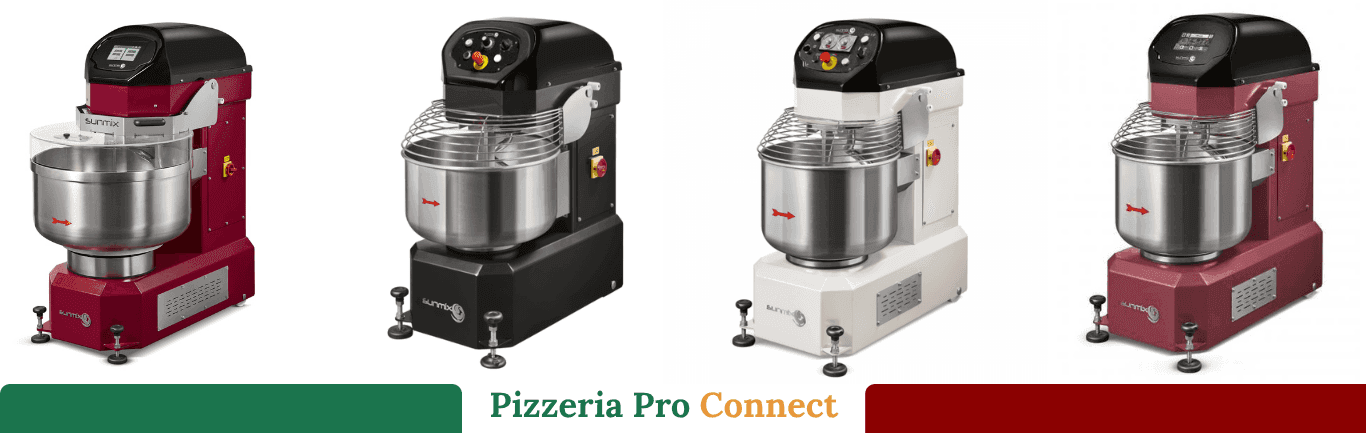
Choosing the right professional
dough mixer for your pizzeria.
How to Choose the Right Professional Dough Mixer
The dough mixer is one of the most important pieces of equipment in a pizzeria. It needs to be able to consistently handle the amount of dough required, without overheating, straining, or slowing down production.
Yet it's still common for people to choose a mixer based solely on its bowl capacity or the number of kilograms stated by the manufacturer.
To make the right choice, several factors need to be considered:
- the type of dough you want to make;
- its hydration level;
- the quantity produced each day;
- the number of mixing cycles needed;
- the machine's minimum and maximum capacity;
- the number of speeds;
- the type of head and bowl;
- the space available in your kitchen;
- the expected growth of your business.
A properly sized mixer should meet your current needs while leaving enough margin to support your pizzeria's growth.
The different types of professional dough mixers
Not all mixers work dough in the same way. The main models used in the pizza world are the spiral mixer, the fork mixer, and the diving-arm mixer.
The spiral mixer
The spiral mixer is the most common model in pizzerias.
It generally has:
- a rotating bowl;
- a spiral that works the dough;
- a central bar that limits how much the dough rotates within the bowl.
The combined rotation of the spiral and the bowl allows large quantities of dough to be kneaded quickly.
Advantages
- Relatively fast kneading.
- Wide choice of capacities.
- Very common among professional equipment manufacturers.
- Suited to many types of pizza dough.
- Reasonable footprint.
- Simple to use.
- Good balance between capacity, speed, and price.
Limitations
A spiral mixer can transfer more energy into the dough than a slower machine. If kneading time, speeds, or temperatures aren't well controlled, the dough can heat up.
This doesn't mean the spiral mixer is bad for dough. You simply need to choose a suitable machine and learn to control:
- the water temperature;
- the kneading time;
- the speed;
- the final dough temperature.
The spiral mixer is generally the most versatile choice for a pizzeria.
The fork mixer
The fork mixer uses a fork-shaped tool that works the dough more slowly and gently.
It's often favored for long fermentations and for doughs where heat buildup needs to be limited.
Advantages
- Gentle dough handling.
- Generally limited heat buildup.
- Good oxygenation.
- Well suited to long fermentations.
- Suitable for certain demanding artisanal productions.
Limitations
- Kneading time is often longer.
- Price is generally higher than a spiral mixer of comparable capacity.
- Machine can be bulkier.
- Fewer models to choose from.
- Slower pace when several kneading cycles need to run back to back.
The fork mixer can be especially appealing to a pizza maker who already knows precisely the type of dough they want to work with.
The diving-arm mixer
The diving-arm mixer replicates a motion close to manual kneading. Its two arms dive into the bowl and gradually stretch the dough.
Advantages
- Very gentle handling.
- Good dough oxygenation.
- Low heat buildup when used correctly.
- Well suited to highly hydrated doughs.
- Preserves the dough's structure.
Limitations
- Higher purchase price.
- Large footprint.
- More complex mechanical maintenance.
- Generally longer kneading time.
- Capacity and pace sometimes less suited to a small pizzeria.
This type of mixer is often chosen for specific productions, highly hydrated doughs, or businesses looking for a particular working method.
The planetary mixer
The planetary mixer is highly versatile. It can take different attachments for mixing, whisking, or kneading.
It can be useful in a kitchen that makes many different preparations, but it isn't the best choice for producing large quantities of pizza dough on a daily basis.
Its hook works the dough differently than a true spiral. As quantities increase, the machine may lack consistency or be put under greater strain.
For small, occasional batches, it can do the job. For a pizzeria producing a large amount of dough every day, a genuine specialized professional mixer is generally the better option.
Fixed head or lift-up head: what's the difference?
Spiral mixers come in several configurations.
The fixed-head, fixed-bowl mixer
On this model, the head and bowl don't lift up or come out.
Advantages
- Simple construction.
- Generally sturdy machine.
- More affordable price.
- Fewer moving mechanisms.
- Suits many pizzerias perfectly well.
- Wide choice of capacities.
Drawbacks
-
Dough must be removed directly from the bowl.
-
When quantities are large, this can be less comfortable. Cleaning the bowl may also require more effort, even though the surfaces remain accessible.
-
A fixed-head mixer is often sufficient for a pizzeria running one or more kneading cycles a day with reasonable quantities.
The lift-up head, fixed-bowl mixer
The head can be raised, but the bowl stays attached to the mixer.
Advantages
- Easier access to the dough.
- More comfortable dough removal.
- Easier cleaning.
- Better visibility inside the bowl.
Drawbacks
- Higher price.
- An additional lifting mechanism.
- Need to check the clearance height above the mixer.
- The bowl can't be moved elsewhere in the kitchen.
This configuration offers more comfort without requiring a fully removable bowl.
The lift-up head, removable-bowl mixer
The head lifts up and the bowl can be taken out of the machine.
Advantages
- Easier dough removal.
- Bowl can be moved around.
- Simpler cleaning.
- Some models allow working with multiple bowls.
- Useful setup for larger productions.
- Greater comfort when working with large dough quantities.
Drawbacks
- Higher purchase price.
- Larger footprint.
- More complex mechanism.
- Bowl weight to take into account.
- Casters or a cart needed for larger models.
The removable bowl becomes especially valuable when dough quantities are large or when several kneading cycles need to be run one after another.
For a small pizzeria, it adds comfort, but it isn't always essential.
One speed, two speeds, or variable speed?
The number of speeds affects how the dough is mixed and developed.
The single-speed mixer
It runs at a single, fixed speed.
Advantages
- Simple to use.
- Generally more affordable.
- Fewer settings.
- Sufficient for certain traditional recipes.
Limitations
- Fewer options for adjusting the kneading process.
- Dough development can take longer.
- Less suited to certain highly hydrated doughs.
- Harder to clearly separate the mixing phase from the development phase.
A single-speed mixer can work well when the recipe is stable and needs remain simple.
The two-speed mixer
The first speed is generally used to mix the ingredients, while the second speeds up dough development.
Advantages
- Greater versatility.
- Better control over the different kneading phases.
- Time savings.
- Well suited to more hydrated doughs.
- Easier to adapt to several methods.
For a professional pizzeria, a two-speed mixer often offers a good balance between simplicity and working flexibility. Two-speed mixers are generally three-phase.
The variable-speed mixer
It allows more precise control over the spiral's speed, and sometimes the bowl's as well.
Advantages
- Adapts to several types of dough.
- Gradual control over the kneading process.
- Well suited to high-hydration doughs.
- Ability to reproduce precise programs.
Limitations
- More settings to master.
- The extra options are only useful if they're genuinely understood and used.
A speed controller doesn't automatically improve the dough. It gives the pizza maker more options, but also requires a good grasp of the method.
How to understand a mixer's capacity
A mixer's capacity can be expressed in several ways:
- bowl volume in liters;
- maximum amount of flour;
- maximum amount of dough;
- minimum amount of dough.
These figures shouldn't be confused with one another.
A 40-liter mixer doesn't mean it can knead 40 kg of dough.
Similarly, a stated capacity of 30 kg may refer to the total dough weight, not the amount of flour.
Always check whether the manufacturer is referring to liters or kilograms.
How to calculate the total dough weight
The total dough weight includes:
- flour;
- water;
- salt;
- yeast;
- any other ingredients.
Let's take a simple example.
You use:
- 10 kg of flour;
- 6.5 liters of water;
- 280 g of salt;
- an amount of yeast suited to the fermentation method used.
Your mixer won't be working 10 kg, but roughly 16.8 kg of dough.
It's this total weight that should be compared against the maximum capacity stated by the manufacturer.
Calculate your needs based on the number of dough balls
To determine the capacity you need, start by calculating your daily production.
The formula is simple:
Number of dough balls × weight per dough ball = total dough weight
For example:
| Number of dough balls | Weight per dough ball | Total dough weight |
|---|---|---|
| 60 | 250 g | 15 kg |
| 100 | 250 g | 25 kg |
| 150 | 250 g | 37.5 kg |
| 200 | 250 g | 50 kg |
| 100 | 300 g | 30 kg |
| 150 | 300 g | 45 kg |
You then need to determine whether this quantity will be made:
- in a single kneading cycle;
- in two kneading cycles;
- across several batches spread through the day.
It's best to plan for a higher capacity
I generally recommend not choosing a mixer whose maximum capacity exactly matches your usual production.
If you regularly prepare 25 kg of dough, choosing a mixer limited to 25 kg means it will almost always be working at its maximum capacity.
It's a bit like driving a car flat out all the time. It can handle it occasionally, but it's not the best way to preserve the mechanics over the long run.
A mixer consistently used at its limit can:
- put more strain on the motor;
- wear out belts and transmission components faster;
- heat up more quickly;
- lose speed with firmer doughs;
- wear out prematurely;
- leave less room to grow production.
It's therefore better to keep some capacity in reserve.
For a typical production of 25 kg of dough, a mixer comfortably capable of handling 30 to 35 kg may make more sense than a model limited to 25 kg.
This margin also helps you plan for:
- growth in customer numbers;
- busier weekends;
- events;
- adding a service;
- opening an extra day;
- future menu changes.
Be careful not to choose a mixer that's far too large
Planning for a margin doesn't mean you should automatically buy the biggest model available.
Every mixer also has a minimum capacity.
A mixer designed for 80 kg of dough won't necessarily handle a small batch of 5 or 8 kg properly. The spiral may not grip the dough enough, and kneading can become inconsistent.
A model that's far too large can also:
- cost more;
- take up more space;
- use more energy;
- be harder to clean;
- make small batches more complicated;
- require a higher-capacity power supply.
The right choice is therefore to plan for a reasonable margin, while staying compatible with the smallest quantities you'll need to produce.
Should you run one large batch or several small ones?
Making all the dough in one go saves time, but requires a sufficiently large machine.
Running several smaller batches can offer more flexibility, but leads to:
- more handling;
- more cleaning;
- longer production times;
- possible differences between batches;
- several final temperatures to keep track of.
The choice depends on how you organize your workflow.
For larger production, it may be preferable to have a mixer sized appropriately to limit the number of cycles, without necessarily making the entire batch in one go.
Hydration level affects the choice
Not all doughs put the same strain on the mixer.
A firm dough generally demands more mechanical effort from the motor than a more hydrated one.
Conversely, a highly hydrated dough may require:
- a second speed;
- variable speed;
- a well-designed spiral;
- an appropriate kneading time;
- a bowl large enough to limit splashing.
The maximum capacity stated by the manufacturer can sometimes vary depending on the type of dough and its hydration.
When requesting a quote, always specify:
- the hydration level;
- the amount of flour;
- the total dough weight;
- the type of flour;
- the approximate kneading time;
- the number of daily cycles.
Check the mixer's power and build quality
Two mixers advertised with the same capacity can have very different motors and construction.
Be sure to check:
- the motor's power;
- the type of transmission;
- the bowl's sturdiness;
- the quality of the spiral;
- whether there's a central bar;
- the machine's stability;
- the total weight;
- the quality of the casters;
- the availability of spare parts.
A heavy, stable machine will move less during kneading, particularly with firm dough or a fully loaded bowl.
Timers and automatic programs
Some mixers feature:
- a timer for the first speed;
- a timer for the second speed;
- automatic switching from one speed to the other;
- several savable programs;
- automatic shutoff.
These features make it easier to reproduce the same method consistently and reduce the risk of forgetting a step during preparation.
However, they don't replace watching the dough itself. Kneading time can vary depending on temperature, flour, or the quantity being worked.
Measure the available space
Before ordering, check:
- the mixer's width;
- its depth;
- its height;
- the height with the head raised;
- the space needed to remove the bowl;
- whether it will fit through doorways;
- the stability of the floor;
- proximity to a power supply;
- the space available to move around it.
A lift-up head mixer may require significantly more clearance height than a fixed-head model.
A removable bowl also needs enough space to be taken out and moved.
Where should the mixer be installed?
The mixer should be installed in a location that is:
- stable;
- easy to clean;
- accessible;
- close to the dough prep area;
- far enough from heat sources;
- compatible with how the team moves around.
Avoid placing it next to the oven or in a very warm area. Ambient temperature directly affects the final dough temperature.
Also plan for nearby space for:
- flour;
- the scale;
- water;
- salt;
- containers;
- dough ball tubs;
- cleaning supplies.
Cleaning the mixer
Check that you can easily clean:
- the bowl;
- the spiral;
- the central bar;
- the safety grille;
- the exterior surfaces;
- the areas underneath the machine.
A lift-up head or removable bowl makes access easier, but a well-designed fixed model can also be maintained effectively.
Comparison table of the main mixer types
| Mixer type | Main advantages | Main limitations |
|---|---|---|
| Spiral | Fast, versatile, wide range of capacities, very well suited to pizzerias | Can heat the dough if parameters aren't well controlled |
| Fork | Gentle handling, low heat buildup, well suited to long fermentations | Slower, bulkier, and often more expensive |
| Diving-arm | Delicate handling, good oxygenation, suited to highly hydrated doughs | High price and large footprint |
| Planetary | Versatile for different preparations | Less suited to large daily production of pizza dough |
Fixed head or lift-up head?
| Configuration | Best suited for |
|---|---|
| Fixed head and bowl | A simple, sturdy, economical solution for regular production |
| Lift-up head, fixed bowl | More comfort for removing dough and cleaning |
| Lift-up head, removable bowl | Large production, need to move the bowl or use multiple bowls |
Checklist before choosing your mixer
Your production
☐ I know how many dough balls I produce each day.
☐ I know their weight.
☐ I've calculated the total dough weight.
☐ I know how many kneading cycles will be needed.
☐ I've factored in needs on the busiest days.
☐ I've planned for possible growth in production.
Capacity
☐ I've checked whether the stated capacity refers to flour or total dough.
☐ I know the mixer's maximum capacity.
☐ I also know its minimum capacity.
☐ I don't plan to run the machine at maximum capacity every day.
☐ I've kept a reasonable margin.
☐ The mixer won't be too large for my smaller batches.
The dough
☐ I've specified my hydration level.
☐ I've factored in the dough's firmness.
☐ The number of speeds suits my method.
☐ The mixer can properly limit heat buildup.
☐ I'll be able to control the final dough temperature.
Configuration
☐ I've chosen between a fixed head and a lift-up head.
☐ I've determined whether a removable bowl is genuinely useful.
☐ I've measured the clearance height needed with the head raised.
☐ There's enough space to remove and move the bowl.
☐ The machine will fit through all access points.
Installation
☐ The power supply is compatible.
☐ The floor is stable.
☐ The mixer won't be placed next to the oven.
☐ There's enough space around the machine.
☐ Cleaning will be easy.
☐ Spare parts and after-sales service are available.
In summary
A professional dough mixer should be chosen based on the actual total dough weight you produce, not just the volume of its bowl.
The spiral mixer remains the most common and versatile model for a pizzeria. The fork mixer offers slower, gentler handling, while the diving-arm mixer is particularly well suited to certain highly hydrated doughs.
A fixed head is a simple, sturdy solution. A lift-up head or removable bowl adds comfort, especially as quantities grow.
It's best to choose a mixer with a capacity slightly higher than your usual needs. A machine constantly run at its limit is a bit like a car driven flat out all the time: it works, but its mechanics are under much greater strain.
This margin also lets you plan for your pizzeria's growth.
That said, you shouldn't oversize the machine excessively either. A mixer that's far too large can handle small quantities poorly and lead to unnecessary expense.
The right mixer, then, is one that can comfortably handle your daily production, absorb busier days, and support your business as it grows, without constantly running at its maximum capacity.
Request a quote
Which model or brand of electric oven interests you? Tell us your needs and we'll get back to you with a personalized offer.
Frequently asked questions
Can't find
the equipment you need?
Looking for a specific brand, a particular model, or professional equipment not yet listed on our site? Send us your request. We can look into your needs, offer you a quote on the equipment you're after, an equivalent solution, or help you find a better deal.