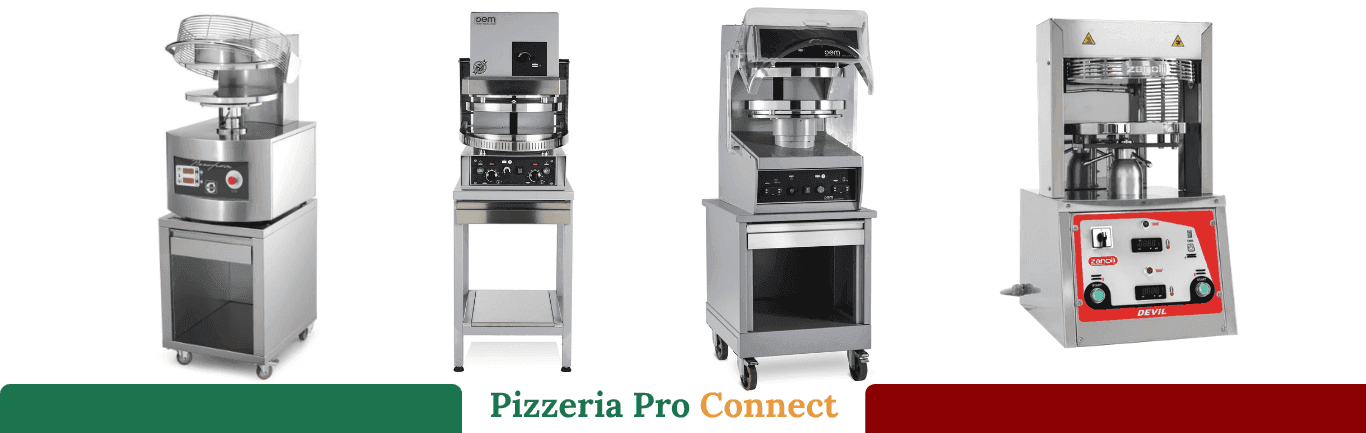

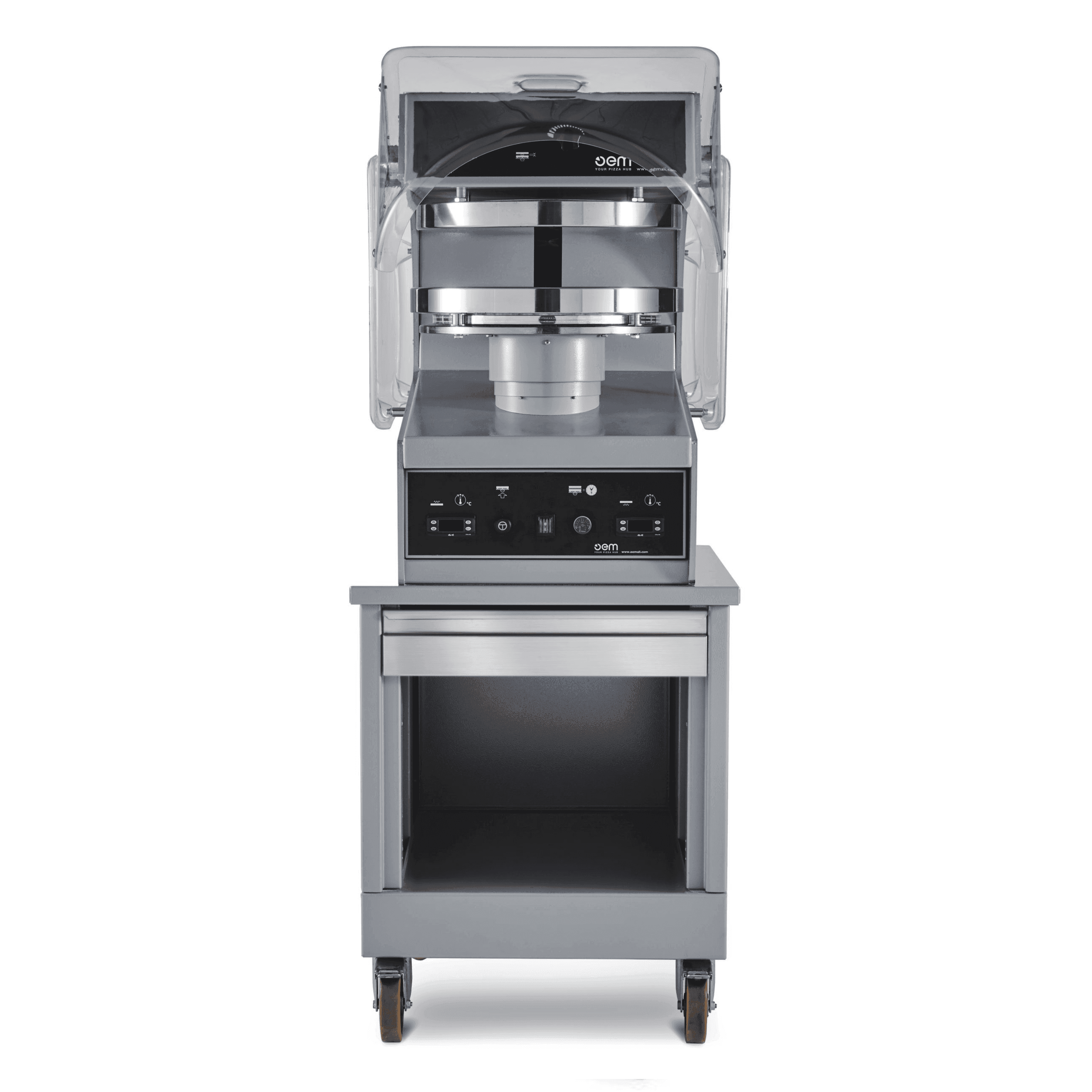
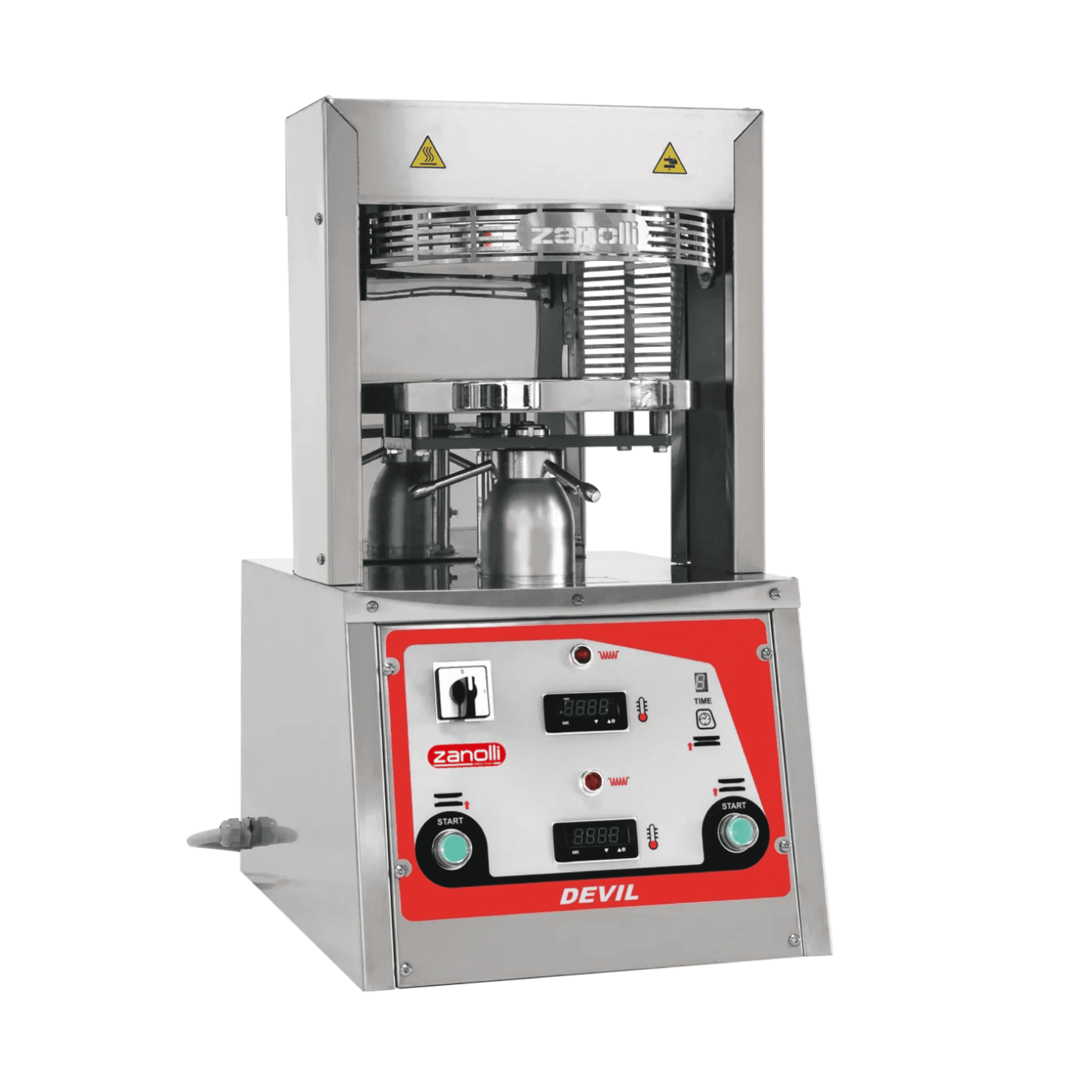
Choosing the right professional
pizza dough sheeter.
How to Choose the Right Professional Pizza Sheeter
Professional pizza sheeters speed up the preparation of dough disks, deliver more consistent results, and significantly reduce the fatigue associated with manual stretching.
They're especially valuable in pizzerias that regularly produce a high volume of pizzas, but also for people working alone who want to save time during preparation and service.
- ⚙️ Significant time savings in preparation
- 🍕 More consistent diameter and thickness
- 🧑🍳 Reduced fatigue for the pizza maker
- 📈 Smoother, more consistent production
- 👥 Can reduce certain staffing needs
What is a pizza sheeter used for?
A pizza sheeter turns a dough ball into a dough disk quickly and consistently.
Depending on the technology used, the dough ball is pressed between two plates to achieve the desired diameter and thickness. Some models also use gentle heating to make shaping the dough easier.
A sheeter helps to:
- reduce the time spent stretching dough;
- produce pizza bases of consistent size;
- limit differences between operators;
- reduce fatigue in the hands, wrists, arms, and shoulders;
- speed up preparation during busy periods.
It's not just a device for stretching a few dough balls more easily. When properly chosen and mastered, a sheeter can become a genuine production tool.
A machine built for a specific diameter
For the plate-style sheeters featured here, it's important to understand that the machine is designed for a specific pizza diameter.
It doesn't come with multiple interchangeable disks that let you freely switch between a 30 cm pizza and a 35 or 40 cm one.
You need to choose your sheeter based on the diameter you actually intend to offer.
For example, a machine built to form 33 cm pizzas will remain limited to that diameter. You can adjust certain working parameters, but you won't turn this machine into a 40 cm sheeter just by swapping an accessory.
Before buying, you should therefore have clearly determined:
- your pizza diameter;
- your dough ball weight;
- the desired thickness;
- the style of pizza you offer;
- the space available in your kitchen.
Choosing the diameter deserves real thought, as it will shape your workflow and menu for the long term.
Flat or curved edges depending on the result you want
Not all sheeters produce exactly the same pizza base.
Some models have relatively flat plates. Others have slightly curved edges that create a more defined rim around the disk.
This shape can help produce a more visible outer rim, sometimes called a "cornicione-style edge," although the result won't be identical to what you'd get from manual stretching aimed at preserving a true Neapolitan cornicione.
Before choosing your machine, take a close look at:
- the shape of the plates;
- the rim design;
- the final diameter;
- the thickness at the center;
- the result after baking.
Ideally, you should run tests with your own dough before making a decision.
A sheeter won't automatically adapt to your dough
There isn't just one type of pizza dough.
Doughs can vary based on:
- the flour;
- hydration level;
- fermentation time;
- temperature;
- dough ball weight;
- any oil content;
- dough strength;
- the style of pizza you're aiming for.
A sheeter has its own operating constraints. Depending on the model, you'll generally be able to adjust thickness, pressure, pressing time, or temperature, but the machine won't fully adapt to just any dough.
In some cases, you'll need to slightly adjust your method or recipe to get a satisfactory result with the sheeter.
This may involve:
- the dough ball's temperature;
- its resting time;
- its hydration;
- its weight;
- its resistance;
- the timing of use after coming out of the fridge.
So you shouldn't buy a sheeter thinking you'll simply drop in your usual dough and get a perfect disk right away.
You'll be able to adjust the machine, but you'll also need to learn how to work your dough with it.
An adjustment period is essential
A professional sheeter requires a certain amount of learning.
During your first trials, you'll need to find the right balance between:
- the dough ball's weight;
- its resting time;
- its temperature;
- the pressure applied;
- the chosen thickness;
- the plate temperature;
- the cycle duration.
Dough that's too cold, too firm, or insufficiently rested may shrink back after pressing. Dough that's over-proofed or too soft may become difficult to handle or lose part of its structure.
You should therefore plan for a period of adjustment and training before using the machine during actual service.
I recommend running several rounds of tests and carefully noting the parameters used. This makes it easier to reproduce the best results.
A sheeter can save an enormous amount of time, but only once the pizza maker has properly mastered the pairing between their dough and their machine.
An investment to weigh against the time actually saved
A professional sheeter represents a real cost. It shouldn't be bought just because it seems convenient or modern.
The real question is:
How much time will this machine save me each day?
If you're only stretching a handful of pizzas per service, the investment may not be a priority.
On the other hand, when you're preparing a large volume of pizzas daily, the time saved can become considerable.
The machine can help you:
- prepare more pizza bases in less time;
- shorten setup time;
- keep service running smoothly;
- reduce fatigue;
- maintain more consistent production;
- free up a staff member for another task.
In some businesses, it can even avoid or delay the need to hire an additional person solely to keep up with increased production.
This doesn't mean a machine automatically replaces an employee. But it can reduce the time spent stretching dough enough to allow the existing team to handle a higher volume of activity.
A real time saver when working alone
A sheeter can also be especially valuable for someone working solo.
When you're handling, on your own:
- dough preparation;
- stretching;
- topping;
- baking;
- orders;
- packaging;
- cleaning;
every minute saved matters.
Reducing the time spent stretching dough can let you start prep later, finish earlier, or simply work in better conditions.
This time saved shouldn't only be seen as extra time to produce more. It can also help you maintain a better personal balance and spend more time with your family.
A professional machine should therefore be evaluated not just on price, but also on the comfort and time it can give back to you each week.
Is a sheeter suited to every type of pizza?
No.
The choice depends heavily on the style of pizza you want to offer.
For classic pizzas
A sheeter can be very useful for classic pizzas, takeaway pizzas, and productions aiming for a consistent diameter and thickness.
It saves time while maintaining a uniform presentation.
For steady or high-volume production
The higher the volume, the clearer the benefit becomes.
It can support:
- takeaway pizzerias;
- chains or businesses built around precise procedures;
- production labs;
- pizzerias employing several staff members;
- professionals wanting to reduce differences between operators.
For Neapolitan pizza
For genuine Neapolitan pizza, you normally don't need this type of equipment.
Manual stretching pushes the gas toward the edge while preserving the dough ball's structure and the future cornicione. Mechanical pressure between two plates risks disrupting this distribution and flattening some of the work built up during fermentation.
If your business is primarily focused on Neapolitan pizza, it's generally better to invest in:
- mastering manual stretching;
- organizing the workstation;
- training the team;
- dough ball consistency.
A sheeter shouldn't be bought purely for speed if it compromises the style of pizza you're trying to deliver.
Criteria to check before choosing
Diameter
The machine must match the diameter you intend to sell. With these plate-style models, you can't freely change diameter using interchangeable disks.
The edge result
Check whether the plates are flat or curved, and look at the shape of the resulting rim.
Available settings
Depending on the model, you may be able to adjust:
- thickness;
- pressure;
- temperature;
- cycle duration.
Compare how precise and simple these settings are.
The type of dough accepted
Ask to test the machine with dough similar to your own. Don't settle for a demo using dough specially prepared by the seller.
Consistency
The disk should maintain a sufficiently even thickness and shouldn't shrink back excessively after shaping.
Footprint
Check:
- width;
- depth;
- height;
- the space needed to work in front of the machine;
- room for the stand or dough ball trays.
Checklist before buying a pizza sheeter
- I've finalized the diameter of my pizzas.
- I understand the machine doesn't have interchangeable disks to change diameter.
- I've checked the shape of the resulting edge.
- The result matches the style of pizza I want to offer.
- My production volume genuinely justifies the investment.
- I've estimated how much time the sheeter could save me.
- I've compared this time savings against the machine's cost.
- I've tested the machine with my own dough, if possible.
- I'm prepared to adjust my dough if needed.
- I've planned for a learning period.
- The thickness and temperature settings are precise enough.
- The available space is sufficient.
- I've identified the necessary accessories.
- Cleaning is straightforward.
- After-sales service is available in my area.
- My business isn't primarily built around genuine Neapolitan pizza.
In summary
A professional pizza sheeter can save an enormous amount of time, reduce fatigue for the pizza maker, and improve production consistency.
It can be a particularly worthwhile investment when volume increases or when someone is working alone. In some cases, the time saved can even support business growth without needing to hire an additional person right away.
But this equipment deserves real consideration.
You need to choose a machine that matches your exact pizza diameter, since plate-style models don't have interchangeable disks that let you freely change the size produced.
You also need to accept an adjustment period. A sheeter won't automatically adapt to every dough. You'll be able to tune certain parameters, but you may sometimes need to evolve your method to achieve a consistent result.
Finally, a sheeter generally isn't essential for Neapolitan pizza, where manual stretching preserves the cornicione and the structure built up during fermentation.
The real value of this machine isn't measured by price alone. It's measured by the hours of work, the fatigue, and the personal time it can save you each week.
Request a quote
Which model or brand of electric oven interests you? Tell us your needs and we'll get back to you with a personalized offer.
Frequently asked questions
Can't find
the equipment you need?
Looking for a specific brand, a particular model, or professional equipment not yet listed on our site? Send us your request. We can look into your needs, offer you a quote on the equipment you're after, an equivalent solution, or help you find a better deal.