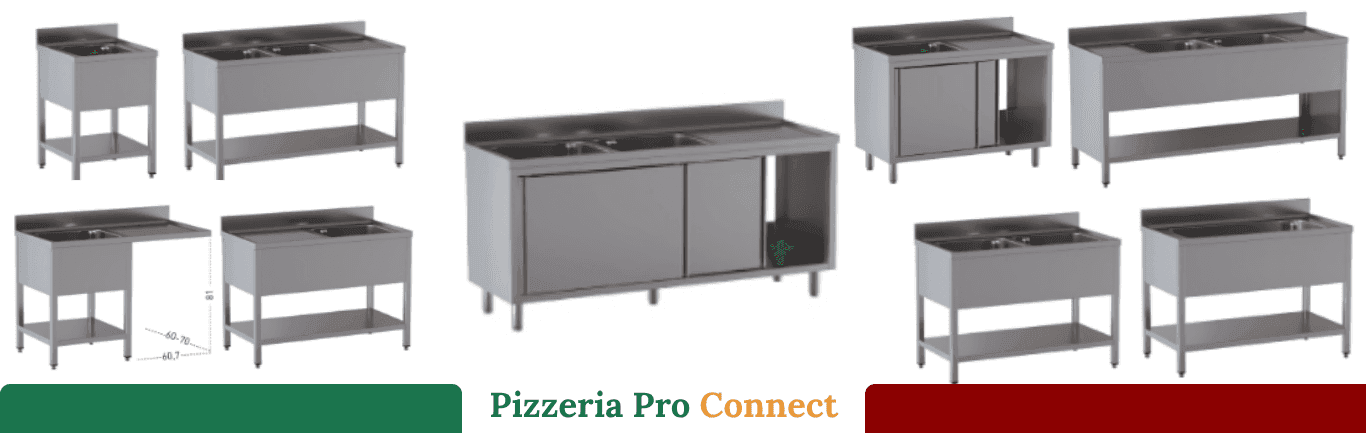
Professional
stainless steel sink.
How to Choose the Right Professional Sink
The sink is an essential element in organizing a pizzeria. It's used to wash dishes, utensils, tubs, and small equipment used during preparation and service.
Choosing one shouldn't be limited to the available width in your kitchen. You also need to consider:
- the volume of dishes to wash;
- whether or not a professional dishwasher is present;
- the depth of the basins;
- the number of basins needed;
- the space set aside for draining;
- the total depth of the sink;
- the overall layout of the kitchen.
A poorly chosen sink can quickly become too small, clutter the work space, or make installing the dishwasher much more complicated.
A vegetable sink is not a substitute for a dish sink
The basin used for washing vegetables must be clearly separate from the sink used for dishware.
It should only be used for washing:
- vegetables;
- fruit;
- fresh herbs;
- food items that need rinsing.
It should not be used for washing plates, utensils, dirty tubs, or prep equipment.
This separation helps prevent contamination and splashing from dirty dishes, cleaning products, or food residue.
A basin without a drainer
The vegetable sink is generally a simple basin without a drainer.
It should be installed in a zone dedicated to food prep, far enough away from the sink used for washing utensils and dishware.
The goal is to prevent splashes of dirty water or cleaning product from reaching vegetables that have already been washed or are being prepped.
The vegetable sink is for food. The dish sink is for equipment and dishware. The two uses must stay separate.
The professional sink for dishware
The standard sink is used to wash:
- dough ball tubs;
- gastronorm containers;
- baking sheets;
- racks;
- utensils;
- containers;
- dishware;
- certain removable equipment parts.
It typically consists of:
- one or more basins;
- a drainer;
- a backsplash;
- a stand or cabinet base;
- possibly a designated space for a dishwasher.
The choice mainly depends on the volume of dishes to wash and how dishware flows through the kitchen.
Why choose a sufficiently deep basin?
Basin depth is especially important in a pizzeria.
A basin that's too small or too shallow quickly becomes uncomfortable when washing bulky items like:
- dough ball tubs;
- GN containers;
- food-grade buckets;
- racks;
- large pots;
- prep accessories.
A sink with a deep basin makes it easier to fully submerge equipment and limits water splashing around the station.
It also makes it easier to soak heavily soiled items before they go through the dishwasher.
Before choosing, check:
- the basin's length;
- its width;
- its depth;
- the dimensions of the largest items you'll need to wash.
The number of basins alone isn't enough to judge the quality of a sink. One large, deep basin can sometimes be more useful than two small, awkward ones.
Single-basin or double-basin sink?
The single-basin sink
A single-basin sink suits businesses with limited space or those relying mainly on a professional dishwasher.
The basin can be used to:
- rinse dishware;
- soak utensils;
- pre-wash heavily soiled items;
- wash equipment that can't go through the machine.
Advantages
- Smaller footprint.
- Wide choice of sizes.
- Room for a wider basin.
- A good fit when the dishwasher handles most of the washing.
- Easier to fit into a small kitchen.
Limitations
- Less separation between different steps.
- Harder to organize when several people are working at once.
- Not well suited to high volume without a dishwasher.
A single-basin sink can be more than enough in a small pizzeria, as long as the basin is properly sized.
The double-basin sink
A double-basin sink makes it easier to separate operations.
For example, you could use:
- one basin for soaking or washing;
- one basin for rinsing.
It can also help separate two types of equipment during busy periods.
Advantages
- More comfortable workflow.
- Separates the different washing steps.
- Better suited to higher volumes.
- Allows two people to work at once.
- Useful when some dishware is washed by hand.
Limitations
- Larger footprint.
- Basins sometimes smaller for the same overall length.
- Potentially higher water consumption.
- Limited benefit if everything goes straight into the dishwasher.
Before choosing two basins, make sure they'll still be large and deep enough for your equipment.
The importance of the drainer
The drainer is used to hold:
- dirty dishware before washing;
- basins waiting to be used;
- rinsed equipment;
- dishwasher baskets;
- clean dishware after washing.
It plays a direct role in organizing the washing workflow.
Depending on the layout, it can be positioned:
- to the right of the basin;
- to the left of the basin;
- on each side for larger installations.
The orientation of the drainer should follow the natural flow of dishware through the kitchen.
For example:
- dirty dishware arrives;
- it's rinsed or pre-washed in the basin;
- it goes through the dishwasher;
- clean dishware comes out.
Poor orientation can force staff to cross paths between dirty and clean dishware.
What is a sink with a dishwasher opening?
A sink with a dishwasher opening is specifically designed to fit a professional dishwasher underneath the drainer.
The space below the sink is left open to allow the machine to be installed.
This setup offers several advantages:
- the dishwasher is fully integrated into the station;
- the drainer can be used to hold baskets;
- the washing workflow is smoother;
- floor space is used more efficiently;
- the installation looks cleaner and more professional.
The dishwasher opening needs to be planned for from the moment you choose the sink. It's often difficult to modify a standard model afterward if it has legs, braces, or a poorly positioned lower shelf.
Why choose a 700 mm depth with a dishwasher opening?
Professional sinks are commonly available in the following depths:
- 600 mm;
- 700 mm.
A 600 mm sink can work for a simple setup without an integrated machine, or for particularly tight spaces.
However, when a dishwasher needs to sit under the drainer, I recommend choosing a sink with a depth of 700 mm.
Better dishwasher integration
A professional dishwasher generally has significant depth. You also need to account for:
- connections;
- the water inlet;
- the drain;
- the power cable;
- pipes at the back;
- the space needed for ventilation and maintenance.
With a 600 mm sink, the machine risks sticking out at the front or being pushed flush against the wall, without enough room for the pipes at the back.
With a 700 mm depth, the dishwasher can be better positioned under the sink. The rear connections have more room, and the whole setup looks much better integrated.
When planning for a dishwasher opening, choose a sink with a depth of 700 mm whenever possible.
The 100 mm difference may seem small on a floor plan, but it genuinely changes the quality of the installation.
The limitations of a 600 mm sink
A 600 mm sink can be a good option when:
- available space is very limited;
- no dishwasher will sit underneath;
- the items to be washed aren't bulky;
- the sink is used only occasionally.
But it can present several difficulties:
- a less comfortable basin;
- the dishwasher sticking out at the front;
- not enough room for connections;
- pipes crushed or poorly positioned;
- more complicated maintenance;
- a less polished overall look.
Before settling on a 600 mm depth just to save space, make sure the installation will actually be functional.
The sink with an opening for a hood-type dishwasher
In businesses with a higher volume of dishwashing, a hood-type dishwasher can be paired with an infeed table and an outfeed table.
The workflow then becomes highly organized:
- dirty dishware is placed on the infeed table;
- it's rinsed in the basin;
- the basket slides into the machine;
- the clean basket comes out the other side;
- the dishware is left to dry.
This setup requires more space, but it considerably improves working comfort during busy services.
It's mainly suited to businesses with a larger dining room or handling a lot of dishware.
The sink's backsplash
The backsplash is the raised section at the back of the sink.
It serves to:
- protect the wall from splashes;
- prevent water from running down behind the cabinet;
- make cleaning easier;
- limit water seeping in between the sink and the wall.
In a professional kitchen, a sink with a backsplash is generally preferable.
Its height should adequately protect the wall without getting in the way of the faucet installation.
Choosing the right faucet
A professional sink needs a faucet suited to its use.
Depending on your needs, you may want:
- a mixer tap;
- a single-lever mixer;
- a professional pre-rinse spray unit;
- a gooseneck spout;
- manual or non-manual controls, depending on your workflow.
The pre-rinse spray unit allows quick rinsing of plates, tubs, and utensils before they go into the machine.
Check:
- the available height;
- the length of the hose;
- the spray reach;
- compatibility with the basins;
- the sturdiness of the mounting;
- the available water pressure.
A spray unit that's mounted too low or has too short a hose will be hard to use with large basins.
Check the connections before ordering
Before choosing the sink, precisely locate:
- the hot water supply;
- the cold water supply;
- the drain;
- the height of the water outlet;
- the dishwasher connections;
- the position of the electrical outlets;
- the space available behind the equipment.
For a sink with a dishwasher opening, the dishwasher's hoses are usually located at the back.
You should therefore avoid pushing the machine completely flush against the wall, and leave enough depth so the hoses aren't crushed or bent.
This is one more reason a 700 mm sink makes sense.
Consider storage under the sink
Some sinks come with:
- a lower shelf;
- an enclosed cabinet;
- sliding doors;
- a fully open space.
A shelf can be used to store equipment, but it may prevent installing a dishwasher.
For a sink with a dishwasher opening, check that:
- the legs don't get in the machine's way;
- no brace blocks its path;
- there's enough clearance height;
- the planned width matches the dishwasher;
- the connections remain accessible.
Don't order a standard sink thinking you can simply remove a shelf later. Braces can be part of the cabinet's structural frame.
What size should you choose?
The size of the sink depends on:
- the number of basins;
- the width of the drainer;
- whether a dishwasher will be installed;
- the dimensions of the baskets;
- the equipment to be washed;
- the available space.
Before ordering, measure:
- the total length of the wall;
- the available depth;
- the clearance height under any shelving;
- the width of the dishwasher;
- the largest basins you'll need to wash;
- the circulation space in front of the sink.
Also plan enough space to fully open the dishwasher door and handle the baskets.
Comparison table
| Sink type | Recommended use | Points to watch |
|---|---|---|
| Vegetable sink | Exclusively for washing vegetables and food items | Keep separate from the dish sink to avoid splashing |
| 1-basin sink | Small pizzeria or use alongside a dishwasher | Choose a basin that's large and deep enough |
| 2-basin sink | Higher-volume manual washing or separating wash/rinse steps | Make sure neither basin is too small |
| Sink with drainer | Placing, rinsing, and drying dishware | Choose the correct side based on the washing workflow |
| Sink with dishwasher opening | Integrating a dishwasher under the drainer | Plan for 700 mm depth and rear connections |
| Sink for hood-type dishwasher | High volume of dishware | Requires more length and precise organization |
Mistakes to avoid
Using the vegetable basin for dishware
Washing food items must stay separate from dirty equipment and cleaning products.
Choosing a basin that's too small
Dough ball tubs and large utensils need to be washable comfortably.
Buying a 600 mm sink with a dishwasher opening
The dishwasher can stick out, lack space at the back, or be poorly integrated.
Forgetting the pipes behind the machine
The stated dimensions for a dishwasher don't always account for the space needed for connections.
Choosing the wrong side for the drainer
The orientation should follow the natural dishware flow, without crossing clean and dirty items.
Not checking the clearance height
The dishwasher needs to fit under the sink, connections and adjustments included.
Forgetting the spray unit
A suitable spray unit saves a lot of time when pre-washing tubs and dishware.
Checklist before choosing your sink
The vegetable sink
☐ A separate basin is planned for washing vegetables.
☐ It won't be used for dishware.
☐ It's far enough away from the dirty dish sink.
☐ Splashes from dishwashing won't be able to reach it.
The dish sink
☐ I've chosen between one or two basins.
☐ The basins are large enough.
☐ Their depth allows for washing dough ball tubs.
☐ A drainer is included.
☐ Its orientation matches the washing workflow.
☐ A backsplash protects the wall.
The dishwasher
☐ A dishwasher opening is planned.
☐ The available width matches the dishwasher.
☐ There's enough clearance height.
☐ I've chosen a sink with 700 mm depth.
☐ The rear hoses have enough room.
☐ The dishwasher won't stick out excessively at the front.
☐ The connections remain accessible for maintenance.
The installation
☐ The water supply points have been identified.
☐ The drain is correctly positioned.
☐ The faucet is suitable.
☐ A professional spray unit is planned if needed.
☐ There's enough circulation space in front of the sink.
☐ The machine's door can open fully.
☐ The sink can be transported into the kitchen.
In summary
Choosing a professional sink depends on the volume of dishware, the equipment to be washed, and whether a dishwasher will be present.
The vegetable sink should be reserved solely for washing food items. It should be kept separate from the sink used for dishware to avoid splashing and contamination.
A single-basin sink may be enough when the business relies mainly on a dishwasher. A double-basin sink offers more comfort for separating washing and rinsing, or for handling a higher volume.
In a pizzeria, it's important to choose basins that are deep enough to wash dough ball tubs and large utensils.
Finally, when a dishwasher needs to be integrated under the drainer, I recommend always choosing a sink with a 700 mm depth and a dishwasher opening. This depth allows for better dishwasher integration and leaves enough room at the back for the pipes and connections.
A 600 mm sink might look sufficient on a floor plan, but the few centimeters saved can end up complicating the entire installation.
Request a quote
Which stainless steel sink model interests you? Tell us your needs and we'll get back to you with a tailored offer.
Frequently asked questions
Can't find
the equipment you need?
Looking for a specific brand, a particular model, or professional equipment not yet listed on our site? Send us your request. We can look into your needs, offer you a quote on the equipment you're after, an equivalent solution, or help you find a better deal.