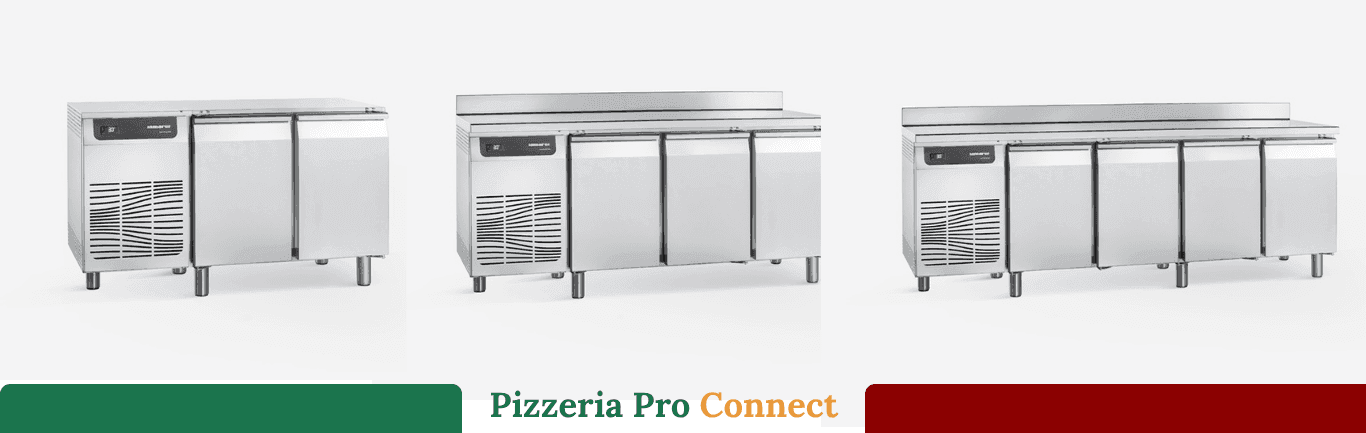
Refrigerated table
for pizzerias.
How to Choose the Right Professional Refrigerated Table
A professional refrigerated table combines cold storage space and a genuine work surface in a single piece of equipment.
Available in 2-door, 3-door, or 4-door versions, with different depths and numerous configurations, it should be chosen based on your storage volume, the space available in your kitchen, and how you organize production.
- ❄️ Ingredients kept close at hand
- 🔪 A genuine stainless steel work surface
- 📦 Storage sized to your production volume
- 🧑🍳 Smoother workflow during preparation
- 📐 Wide range of sizes and configurations
- 🌡️ Tropicalized models for hot environments
What is a professional refrigerated table used for?
A refrigerated table is a low cabinet fitted with a refrigeration unit and topped with a worktop.
It keeps ingredients cold while providing a surface for:
- prepping ingredients;
- cutting ingredients;
- organizing orders;
- placing small equipment;
- working dough balls;
- certain preparations before service.
Its main advantage is placing ingredients directly under the worktop.
This means the pizza maker or cook makes fewer trips between the prep station and a refrigerated cabinet located elsewhere in the kitchen.
Depending on the model, it can hold:
- gastronorm containers;
- racks;
- shelves;
- drawers;
- bakery sheet pans;
- storage tubs;
- certain dough ball tubs.
The refrigerated table therefore becomes a central element in organizing the kitchen.
Refrigerated table vs. pizza prep table: what's the difference?
A standard refrigerated table is primarily designed as a worktop with cold storage space underneath.
A pizza prep table generally has a deeper worktop and can include a refrigerated display case or a structure designed to hold the ingredient tubs used for topping.
The standard refrigerated table is often more versatile.
It can be used for:
- prepping vegetables;
- storing ingredients;
- preparing desserts;
- working meat;
- storing fresh produce;
- general kitchen mise en place.
The choice therefore depends on how you plan to use it and the space available in your business.
2-door refrigerated table
The 2-door refrigerated table is the most compact.
It's particularly suited to:
- small kitchens;
- pizzerias with limited space;
- businesses with moderate storage needs;
- secondary prep stations;
- professionals looking to supplement an existing refrigerated cabinet.
It offers a relatively short worktop, but still allows you to keep a good quantity of ingredients right at the station.
It can also be installed alongside another piece of equipment to create a more complete work line.
Before choosing a 2-door table, however, make sure its interior volume will be enough for your future activity. Buying a table that's too small can quickly become a constraint as production grows.
3-door refrigerated table
The 3-door refrigerated table often strikes a good balance between storage capacity, worktop length, and footprint.
It suits many pizzerias and professional kitchens.
It allows you to create several storage zones, for example:
- one door for vegetables;
- one door for dairy products;
- one door for the day's preparations.
The worktop length also lets you organize several prep steps without taking up all the available space.
A 3-door table can be especially useful when several people work in the kitchen or when production volume starts to grow.
4-door refrigerated table
The 4-door refrigerated table offers greater storage volume and a particularly long worktop.
It's suited to:
- high-activity businesses;
- large kitchens;
- teams working together;
- professionals wanting to centralize a large share of their ingredients;
- kitchens needing several distinct storage zones.
Its main advantage is its capacity.
It lets you store more products and organize each compartment more precisely.
That said, its footprint is significant. You need to check that it won't get in the way of:
- movement;
- door opening;
- moving tubs around;
- access to other equipment;
- cleaning the kitchen.
A bigger table isn't automatically more practical. It needs to match your actual workflow.
Choosing the number of doors based on your activity
The choice between 2, 3, or 4 doors shouldn't be based solely on available space.
You should also factor in:
- the number of ingredients to store;
- the number of services you run;
- your production volume;
- how often deliveries arrive;
- the number of people working at the station;
- whether you have a walk-in cooler or a refrigerated cabinet;
- your expected business growth.
A refrigerated table doesn't need to hold your entire stock.
It can serve as a nearby supply, while larger quantities are kept in a walk-in cooler or storage cabinet.
This setup lets you keep only the products needed for service or for the day in the table.
With or without a backsplash
Refrigerated tables can be offered with or without a backsplash.
What is a backsplash?
The backsplash is the vertical rim at the back of the worktop.
It's generally a few centimeters high and extends up against the wall.
It helps to:
- prevent items from falling behind the table;
- limit splashing against the wall;
- make cleaning the back area easier;
- stop certain liquids from running between the table and the wall;
- protect the wall during preparation.
A table with a backsplash
The version with a backsplash is especially useful when the table is installed directly against a wall.
It creates a small protective barrier between the worktop and the wall.
It's often chosen for cutting stations or preparations likely to cause splashing.
The backsplash also makes daily cleaning easier, since residue is less likely to fall behind the cabinet.
A table without a backsplash
A table without a backsplash has a completely flat worktop.
It can be preferable when:
- the table is installed in the center of the kitchen;
- the worktop needs to be accessible from both sides;
- a granite slab will be installed;
- several units need to be joined under a single worktop;
- you want a visually continuous surface.
The choice therefore depends on where the table will be placed and your planned layout.
The different depths
The depth of the table directly affects:
- the size of the worktop;
- the interior capacity;
- the type of tubs or sheet pans that can be used;
- the space it takes up in the kitchen;
- working comfort.
The most common depths are roughly 600, 700, and 800 mm.
Exact dimensions can vary by manufacturer.
600 mm depth refrigerated table
600 mm deep tables are often chosen for tight spaces.
They help maintain more comfortable circulation in small kitchens or very narrow businesses.
They can suit:
- snack bars;
- small pizzerias;
- well-equipped food trucks;
- kitchens with limited depth;
- secondary prep stations.
Their worktop is less deep, which can be enough for certain tasks but more limiting for working with large tubs or organizing several preparations.
Interior capacity may also be smaller.
Before buying, check precisely the dimensions of the racks, tubs, and containers it accepts. An outer depth of 600 mm doesn't always guarantee the same interior layout from one brand to another.
700 mm depth refrigerated table
The 700 mm depth is very common in professional kitchens.
It generally offers a good balance between:
- work surface;
- interior volume;
- compatibility with gastronorm containers;
- ease of use;
- footprint.
This depth suits the majority of pizzerias and restaurants.
It provides a sufficiently comfortable worktop without taking up as much space as an 800 mm table.
Depending on the model, it can hold racks, shelves, or gastronorm containers of various sizes.
The 700 mm depth is often the most versatile choice for daily use.
800 mm depth refrigerated table
800 mm deep tables offer a larger work surface and greater interior capacity.
They're especially useful for kitchens using 400 × 600 mm sheet pans or racks.
Depending on the table's design, you'll be able to store:
- 400 × 600 mm sheet pans;
- 400 × 600 mm racks;
- certain dough ball tubs;
- preparations made on sheet pans;
- bakery or pastry products.
This depth can therefore be particularly well suited to pizzerias that also prepare:
- fresh pasta;
- desserts;
- bakery products;
- focaccia;
- preparations made on sheet pans.
It also offers a more comfortable worktop for certain tasks.
That said, an 800 mm table takes up more space in the kitchen. Check that it won't excessively narrow the walkway between two lines of equipment.
It's recommended to measure your space accounting for the table's actual depth, as well as door clearance and the room needed to work in front of it.
Carefully check interior dimensions
Two tables with nearly identical outer dimensions can offer different interior capacities.
The refrigeration unit, insulation thickness, and compartment design can all reduce usable space.
Before buying, check:
- the interior dimensions;
- the rack size;
- the number of levels;
- the spacing between the runners;
- whether racks are included;
- compatibility with your tubs;
- the actual number of containers you can store.
Don't rely solely on the volume stated in liters.
Ask yourself what you'll actually be able to fit inside.
The stainless steel top
Most professional refrigerated tables come with a stainless steel top.
Stainless steel is particularly well suited to professional kitchens because it is:
- durable;
- hygienic;
- easy to clean;
- suitable for food contact;
- not very sensitive to moisture;
- long-lasting when properly maintained.
The stainless steel top can be offered:
- with a backsplash;
- without a backsplash;
- with a drop edge;
- in different thicknesses;
- with reinforcements underneath the worktop.
For intensive use, the rigidity of the top matters.
A worktop that's too thin can warp or vibrate when you're using heavy equipment.
Ordering a refrigerated table without a stainless steel top
Some manufacturers let you order the refrigerated table without its stainless steel top.
You then receive only the refrigerated base.
This option lets you install a different worktop on top, for example:
- a granite surface;
- natural stone;
- a composite material;
- a custom-made worktop;
- a single top shared across several units.
This configuration is especially useful in fully custom-designed kitchens.
Installing a granite worktop
Granite is often favored for working dough.
It offers a surface that's:
- sturdy;
- stable;
- easy to clean;
- durable;
- pleasant for certain preparations.
By ordering tables without a stainless steel top, you can install a large granite slab across several units.
This lets you create a continuous worktop.
The absence of gaps between the different units avoids visible seams and small spaces where flour, residue, or liquids can build up.
The result is generally more attractive, but also easier to maintain.
Installation must be done correctly, though, so as not to block:
- ventilation;
- access to the refrigeration unit;
- maintenance operations;
- the possible removal of a table;
- air circulation around the equipment.
Creating a continuous worktop with several tables
You can install several refrigerated tables under a single worktop.
For example, you could combine:
- a 2-door refrigerated table;
- a 3-door refrigerated table;
- a neutral cabinet;
- a space reserved for a piece of equipment.
A single large worktop can then be placed on top of the whole setup.
This lets you create a truly custom production line.
There will be no seam between two tables, and you'll get a uniform surface.
It also eliminates small gaps between units, which are often hard to clean.
Leaving space for the mixer
It's also possible to leave a gap between two refrigerated tables to fit a dough mixer in.
For example, you could place:
- a refrigerated table on the left;
- the mixer in the center;
- a second refrigerated table on the right;
- a continuous worktop over the whole setup, if the mixer's height and design allow it.
This setup lets you integrate the mixer directly into the prep line.
You do need to check:
- the mixer's exact width;
- its height;
- the clearance needed for the head, if it lifts up;
- access to the bowl;
- motor ventilation;
- whether the mixer can be moved;
- cleaning around the machine;
- the space needed for maintenance.
Don't design too tight a space.
A few extra centimeters may be needed to pull the mixer out, clean around its sides, or service the motor.
Doors or drawers
Some refrigerated tables can be configured with doors, drawers, or a combination of both.
Doors
Doors let you store:
- bulky items;
- tubs;
- bottles;
- racks;
- containers of various heights.
They offer more freedom in organizing the interior.
Drawers
Drawers make ingredients easier to access.
You can quickly see the contents and avoid having to bend down to find something at the back.
They can be especially useful for:
- frequently used ingredients;
- small tubs;
- portioned ingredients;
- service-day preparations.
That said, they're generally more expensive and need to be matched to the size of the containers you use.
A combination of doors and drawers can be an excellent solution for creating a station genuinely suited to your needs.
Fan-assisted cooling
Most professional refrigerated tables use fan-assisted cooling.
Cold air circulates through the different compartments to spread the temperature more evenly.
Fan-assisted cooling generally provides:
- better temperature uniformity;
- faster temperature recovery after opening;
- cold air circulation between the different levels;
- better suitability for frequent openings.
This technology is especially useful during service, when doors or drawers are opened regularly.
That said, avoid overloading the table.
Products shouldn't block the circulation of cold air.
Always leave enough space around the air vents, and don't press tubs flush against the walls if the manufacturer recommends a ventilation gap.
The built-in refrigeration unit
Most refrigerated tables have a built-in refrigeration unit, often placed on one side of the cabinet.
This is known as a built-in unit.
The unit can be positioned:
- on the right;
- on the left;
- sometimes in the center, depending on the design;
- in a dedicated technical compartment.
The unit's location takes up part of the storage volume.
A 3-door table, for example, may have several storage compartments plus an area reserved for the refrigeration system.
Before buying, check which side the unit is on.
This can matter for:
- maintenance access;
- kitchen layout;
- proximity to a heat source;
- ventilation;
- installation next to another unit.
Remote unit
For certain projects, it's possible to choose a table without a built-in refrigeration unit and connect it to an external refrigeration system.
This option can help:
- reduce the heat given off in the kitchen;
- lower noise near the workstation;
- centralize several refrigeration systems;
- improve comfort in very hot kitchens.
It does, however, require installation by a refrigeration professional and generally represents a larger investment.
This configuration is mainly considered for large-scale projects or fully custom-designed kitchens.
Choosing a tropicalized table
A pizzeria kitchen can get very hot.
The oven, cooking equipment, motors, repeated door openings, and outdoor temperature can significantly raise the kitchen's ambient temperature.
A tropicalized refrigerated table is designed to operate in higher ambient temperatures than a standard unit.
It generally features components sized to better withstand heat, including:
- a more suitable refrigeration unit;
- greater cooling capacity;
- reinforced ventilation;
- a condenser designed for demanding environments;
- effective insulation.
The term "tropicalized," however, shouldn't be taken at face value without verification.
Ask the supplier about:
- the maximum ambient temperature it's rated for;
- the exact climate class;
- the conditions under which performance was tested;
- the guaranteed interior temperature;
- the clearance required around the unit;
- installation recommendations.
Two manufacturers can use the term "tropicalized" for very different performance levels.
So it's important to check the precise technical specifications.
Why tropicalization matters in a pizzeria
A table can work perfectly well in an air-conditioned showroom and struggle once installed near an oven.
When ambient temperature gets too high, an undersized unit can:
- run almost continuously;
- consume more electricity;
- struggle to bring the temperature back down;
- wear out prematurely;
- fail to properly preserve ingredients;
- cause significant temperature fluctuations.
Tropicalization is especially important when the table is installed:
- in a small kitchen;
- near an oven;
- in a hot climate;
- in a poorly ventilated kitchen;
- in a business open during summer;
- in a room without air conditioning.
The choice should be based on the actual conditions of your kitchen, not just the average room temperature when no equipment is running.
Don't place the table against the oven
Even a tropicalized table shouldn't be installed just anywhere.
Avoid placing it directly against:
- a pizza oven;
- a fryer;
- a cooktop;
- any appliance that gives off a lot of heat;
- a wall heated by nearby equipment.
Heat forces the refrigeration unit to work harder.
This can lead to:
- higher electricity consumption;
- faster compressor wear;
- difficulty maintaining temperature;
- increased heat in the kitchen.
Whenever possible, leave a gap or a barrier between hot equipment and refrigerated equipment.
An insulating partition or a neutral cabinet can sometimes help limit direct heat exposure.
The importance of ventilation
The refrigeration unit needs to be able to release the heat it produces while running.
Never block:
- ventilation grilles;
- air intakes;
- hot air outlets;
- access to the condenser.
When several tables are installed under a continuous worktop, the overall design needs to maintain sufficient ventilation.
Poor ventilation can reduce the table's performance and cause the unit to wear out prematurely.
You should also plan for access to regularly clean the condenser.
In a pizzeria, flour, dust, and grease can build up quickly in this area.
Choosing the refrigerant gas
Many recent professional refrigerated tables use a refrigerant such as R290.
The type of refrigerant affects:
- the circuit's design;
- performance;
- environmental impact;
- maintenance requirements;
- technician servicing.
The choice of gas shouldn't be the only criterion, though.
A table using a modern refrigerant can still fall short if its unit is undersized, its insulation too weak, or its ventilation poorly designed.
The equipment needs to be assessed as a whole.
Why choose high-end equipment?
A refrigerated table is used every day and is often opened dozens of times during a single service.
It operates in a demanding environment:
- heat;
- humidity;
- flour;
- grease;
- frequent openings;
- impacts;
- intensive cleaning;
- prolonged use.
High-end equipment represents a larger investment, but it can offer:
- better temperature stability;
- faster cold recovery;
- more effective insulation;
- a better-sized refrigeration unit;
- sturdier hinges;
- more durable seals;
- better-fitting doors;
- more resistant stainless steel;
- more robust runners;
- better-controlled noise levels;
- easier cleaning;
- more responsive after-sales service;
- better availability of spare parts.
Purchase price shouldn't therefore be the only point of comparison.
A cheap table can end up costing more over time
An inexpensive refrigerated table may seem sufficient when you're first opening.
But if it's poorly suited to the heat in your kitchen or to how often you use it, it can lead to:
- higher electricity consumption;
- temperature fluctuations;
- frequent repairs;
- seals wearing out quickly;
- doors that don't close properly;
- lost product;
- production interruptions;
- premature replacement.
A refrigerated table breaking down in the middle of summer can end up costing far more than the price difference between two models.
You need to factor in:
- the cost of lost product;
- the cost of repairs;
- how urgent the repair is;
- the time needed to transfer goods elsewhere;
- the risk of service disruption.
The details that set models apart
When two tables seem identical, look closely at:
- the thickness and finish of the stainless steel;
- the rigidity of the worktop;
- the quality of the handles;
- the sturdiness of the hinges;
- how easy the seals are to replace;
- the door-closing system;
- the number of runners;
- the quality of the included racks;
- the accuracy of the thermostat;
- access to the refrigeration unit;
- the noise level;
- whether it has casters or adjustable feet;
- how easy the condenser is to clean;
- the availability of spare parts.
These details may seem minor, but they can make a big difference after several years of use.
Feet or casters
A refrigerated table can be installed on feet or on casters.
Adjustable feet
Feet allow you to:
- adjust the height;
- compensate for an uneven floor;
- stabilize the table;
- level the worktop.
They can, however, make cleaning underneath the unit harder if space is limited.
Casters
Casters make it easier to move the table for:
- cleaning the floor;
- accessing the wall;
- performing maintenance;
- reorganizing the kitchen.
They need to be sturdy enough to support the weight of a loaded table.
At least some of the casters should have a locking system so the unit stays stable while you work.
Worktop height
The table's height directly affects the pizza maker's comfort.
A surface that's too low can force you to bend over constantly. One that's too high can strain the shoulders and make certain tasks difficult.
Take into account:
- the height of the table;
- the thickness of the stainless steel top;
- the thickness of any granite added;
- the height of the feet or casters;
- the height of the people working at the station.
When you add a granite worktop, the final height can increase by several centimeters.
This thickness needs to be factored in from the very start of the kitchen design.
Cleaning and maintenance
A refrigerated table needs daily maintenance.
Regularly clean:
- the top;
- the handles;
- the door seals;
- the racks;
- the runners;
- the interior walls;
- the drains;
- the areas under the drawers.
The condenser should also be dusted according to the manufacturer's recommendations.
A buildup of dust, flour, or grease can reduce the unit's ability to release heat.
This increases energy consumption and the risk of breakdown.
Calculate your actual storage needs
Before choosing, take an inventory of the products that will be kept in the table.
Note down:
- the number of tubs;
- their dimensions;
- their height;
- the products stored;
- the quantities needed for a service;
- how often you restock;
- any bulky items.
This will help you determine whether you need a table with:
- 2 doors;
- 3 doors;
- 4 doors;
- drawers;
- 600 mm depth;
- 700 mm depth;
- 800 mm depth.
Planning for a small margin is useful, but buying a table that's far too large also leads to unnecessary energy consumption and wasted space.
Checklist before buying a refrigerated table
- I've calculated my actual storage needs.
- I've chosen between 2, 3, or 4 doors.
- The table's length matches the available space.
- The 600, 700, or 800 mm depth matches how I'll use it.
- I've checked the usable interior dimensions.
- My tubs, racks, or sheet pans are compatible.
- The 800 mm model properly accepts my 400 × 600 mm sheet pans.
- I've chosen between a version with or without a backsplash.
- I know whether I want to keep the stainless steel top.
- I've looked into installing a granite worktop.
- The final worktop height is suitable.
- The table can be integrated into my custom layout.
- The space planned for the mixer is wide enough.
- The unit's ventilation won't be blocked.
- The table won't be placed flush against the oven.
- I've accounted for my kitchen's maximum temperature.
- The climate class matches my operating conditions.
- The model is sufficiently tropicalized.
- The refrigeration unit is properly sized.
- The fan-assisted cooling circulates correctly.
- The doors and drawers match my workflow.
- The interior is easy to clean.
- The condenser is easily accessible.
- The seals are replaceable.
- Spare parts are available.
- After-sales service covers my area.
- I've compared purchase cost against lifespan and build quality.
In summary
A professional refrigerated table should be chosen based on your storage volume, the space available, and your daily workflow.
A 2-door table suits tight spaces or moderate needs. A 3-door table offers a good balance between capacity and footprint. A 4-door table is better suited to larger production and bigger kitchens.
Depth also deserves careful thought.
A 600 mm table saves space. A 700 mm depth offers great versatility. An 800 mm table can, depending on the model, hold 400 × 600 mm racks or sheet pans and suit larger production needs.
The choice between a version with or without a backsplash will depend on where the table is placed and your layout plans.
It's also possible to order certain refrigerated bases without a stainless steel top in order to install a granite worktop. This lets you combine several tables under a single surface, avoid visible seams, and even leave a gap between two units to fit your mixer.
Finally, never underestimate your kitchen's temperature conditions.
A table installed near an oven needs to be powerful enough, properly ventilated, and genuinely suited to high heat. Choosing a tropicalized, high-end model may represent a larger upfront investment, but it often delivers better temperature stability, a longer lifespan, and more reliable after-sales service.
A refrigerated table is used daily for many years. It shouldn't be chosen on price alone, but on its ability to properly preserve your products, withstand your kitchen's conditions, and fit lastingly into your workflow.
Request a quote
Which model or brand of electric oven interests you? Tell us your needs and we'll get back to you with a personalized offer.
Frequently asked questions
Can't find
the equipment you need?
Looking for a specific brand, a particular model, or professional equipment not yet listed on our site? Send us your request. We can look into your needs, offer you a quote on the equipment you're after, an equivalent solution, or help you find a better deal.