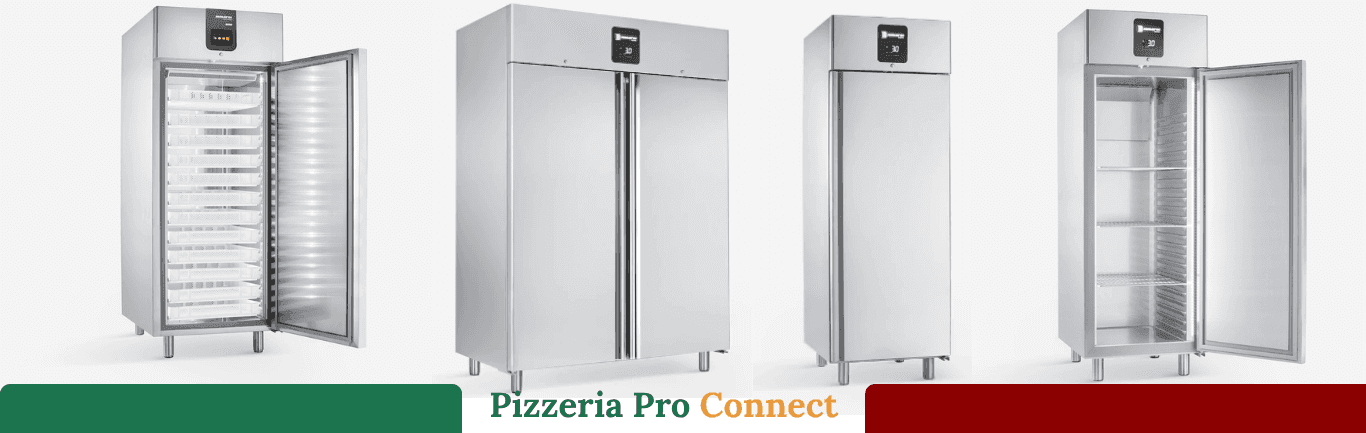
Choosing the right professional
refrigerated cabinet.
How to choose the right professional refrigerated cabinet for a pizzeria
A professional refrigerated cabinet is an essential piece of equipment in a pizzeria. It is used to store everyday ingredients, prepared foods, fresh products, as well as dough balls or fresh pasta depending on the model selected.
As with a pizza prep table, a refrigerated cabinet should not be chosen based solely on its appearance or price. Two cabinets may look very similar while offering very different cooling performance, especially in a hot kitchen or during periods of extreme heat.
What is a refrigerated cabinet used for in a pizzeria?
In a pizzeria, a refrigerated cabinet can serve several purposes:
- 🧀 Storage of everyday ingredients
- 🍕 Storage of dough balls
- 🍝 Storage of fresh pasta
- 🥫 Organization of prepared products
- ❄️ Keeping temperature-sensitive products refrigerated
Your requirements will depend on the way you work. A pizzeria that manages large quantities of dough undergoing long maturation will not have the same needs as an establishment mainly looking to store ingredients for daily service.
The different types of refrigerated cabinets
There are several types of professional refrigerated cabinets. The right choice depends on your activity, production volume and kitchen organization.
Standard refrigerated storage cabinets
Standard refrigerated storage cabinets are used to store everyday ingredients such as cheese, cured meats, vegetables, sauces, prepared foods and other fresh products.
They are available in different capacities, usually with one or two doors depending on the required storage volume. They are practical for organizing products used every day and keeping additional stock easily accessible in the kitchen.
Refrigerated cabinets for dough trays
Refrigerated cabinets for dough trays are specifically designed to accommodate the trays commonly used in pizzerias. They allow dough balls to be stored in suitable conditions during resting, fermentation or maturation.
This is a particularly useful solution for pizzerias that prepare their dough in advance and want to organize their dough trays efficiently without wasting space.
Refrigerated cabinets for fresh pasta
Some cabinets are also suitable for storing fresh pasta or other specific preparations. They provide a controlled refrigerated environment with consistent temperatures and easy daily access.
Before choosing a model, it is therefore important to determine exactly what you intend to store: ingredients, dough balls, fresh pasta or a combination of different products.
Single-door or double-door: which capacity should you choose?
Refrigerated cabinets are available in different capacities, generally with one or two doors.
A single-door cabinet may be sufficient for a small pizzeria, a limited space or an additional storage requirement. It takes up less room and is easier to integrate into a compact kitchen.
A double-door cabinet provides greater storage capacity. It makes it easier to organize products, separate different categories of ingredients or store a larger number of dough trays. However, it also requires more space and can be more difficult to deliver and install.
Before choosing, check:
- the internal storage capacity;
- the number of shelf levels;
- compatibility with your trays;
- the available space in the kitchen;
- the width of doors and access points;
- circulation space around the cabinet;
- your actual daily storage requirements.
Refrigeration performance: an essential criterion
The main purpose of a refrigerated cabinet is to maintain a stable temperature, even when the kitchen becomes hot or the doors are opened frequently.
In a pizzeria, refrigeration equipment can be heavily stressed by oven heat, repeated door openings, long service periods, busy production and periods of extreme summer temperatures. A poorly sized or low-performance cabinet may struggle to maintain the required temperature under these conditions.
It is therefore important to consider the refrigeration system, compressor capacity, insulation quality and the cabinet’s ability to operate effectively in a hot environment.
Pay attention to refrigerant gases
As with pizza prep tables, refrigerated cabinets can use different refrigerant gases. Two cabinets may look identical from the outside while delivering very different performance depending on the refrigerant used, the power of the refrigeration unit and the overall quality of construction.
The refrigerant is not the only factor, but it is one of the elements that should be checked. You should also consider:
- the climate class;
- the maximum ambient temperature supported;
- the type of refrigeration system;
- the quality of the insulation;
- compressor power;
- ventilation;
- the intended position of the cabinet in the kitchen.
A cabinet that performs perfectly well in a temperature-controlled room may reach its limits in a very hot pizzeria kitchen. This is why it is preferable to choose equipment genuinely designed for intensive professional use.
Choose higher-quality equipment for periods of extreme heat
Periods of extreme heat place increasing pressure on professional refrigeration equipment. A refrigerated cabinet installed in a hot kitchen must be capable of maintaining its temperature without the compressor operating continuously at maximum capacity.
Entry-level equipment may appear attractive at the time of purchase, but it can quickly become problematic if it cannot maintain the required temperature.
Investing in a more robust refrigerated cabinet can reduce the risk of:
- temperature fluctuations;
- excessive compressor operation;
- breakdowns during service;
- poor food preservation;
- expensive technical interventions;
- premature replacement of the equipment;
- loss of stock.
In a pizzeria, refrigeration is just as important as the oven. A refrigerated cabinet failure can disrupt the entire production process.
Do not install the cabinet too close to the oven
The position of the refrigerated cabinet is very important. Avoid installing it directly beside the pizza oven or another major heat source.
If the cabinet is located too close to the oven, the refrigeration unit will have to work harder to maintain the required temperature. This can increase energy consumption, place additional stress on the compressor and reduce performance, particularly during hot weather.
Allow sufficient airflow around the cabinet, follow the manufacturer’s installation recommendations and make sure the ventilation grilles are never obstructed.
Even a high-end refrigerated cabinet must be installed correctly to perform properly.
Check dimensions and access before delivery
A professional refrigerated cabinet can be heavy, bulky and difficult to move. Before ordering, always check the dimensions of the packaged equipment as well as access to the premises.
This is particularly important for double-door cabinets and high-capacity models.
Check:
- door widths;
- ceiling height;
- steps or stairs;
- corridor widths;
- access to the kitchen;
- whether the delivery vehicle can park nearby;
- access through narrow streets or city-centre locations.
As with large pizza prep tables, some equipment may require a larger delivery vehicle or a special delivery service. In city centres, narrow streets or difficult-access locations, this can complicate delivery and result in additional costs.
This should be checked before placing the order, not on the day the delivery driver arrives.
Check the accessories and available options
A refrigerated cabinet is rarely just a “large refrigerator”. Depending on the model, several accessories and options may be useful or necessary.
Before approving a quotation, check:
- the number of shelves supplied;
- compatibility with dough trays;
- available shelf runners;
- castors or adjustable feet;
- door opening direction;
- lock;
- type of refrigeration;
- operating temperature;
- climate class;
- automatic defrosting;
- interior lighting;
- digital temperature display;
- top-mounted or bottom-mounted refrigeration unit depending on the model.
For a cabinet specifically designed for dough trays, make sure that the trays used in your pizzeria are compatible with the cabinet’s internal dimensions.
Do not confuse stated capacity with usable capacity
The stated litre capacity provides an indication of overall storage volume, but it does not tell the whole story. A cabinet may offer a large nominal capacity while being less practical because of its internal layout.
You should look at the space that can actually be used:
- number of shelf levels;
- space between shelves;
- internal depth;
- compatibility with trays;
- ease of access;
- ability to store products without overcrowding.
A good refrigerated cabinet should allow products to be stored neatly without overloading the interior. If cold air cannot circulate properly, temperatures may become less consistent throughout the cabinet.
Choose according to your dough management method
For dough balls, choosing the right refrigerated cabinet is particularly important. A pizzeria using long maturation times will need well-organized storage with sufficient space for all its trays.
Consider:
- the number of dough balls prepared each day;
- the number of maturation days;
- tray dimensions;
- available cabinet capacity;
- dough rotation;
- quick access during service;
- the required storage temperature.
A cabinet that is too small forces staff to stack, compress or poorly organize the trays. Over time, this can waste time and make kitchen operations less efficient.
In summary
Choosing the right professional refrigerated cabinet is not simply a matter of deciding between one door and two doors. You need to consider the real intended use: ingredient storage, dough ball storage, fresh pasta, daily production volume, kitchen temperature and working organization.
Before ordering, always check:
- storage capacity;
- number of doors;
- intended use: ingredients, dough balls or fresh pasta;
- climate class;
- type of refrigerant gas;
- ability to operate in high ambient temperatures;
- insulation quality;
- refrigeration unit ventilation;
- position within the kitchen;
- distance from the oven;
- delivery dimensions;
- accessories supplied;
- available options;
- compatibility with your trays.
A refrigerated cabinet is used every day. It is better to choose a reliable, correctly sized model that is genuinely suited to your pizzeria rather than equipment that is only just powerful enough and may become a problem during the first period of extreme summer heat.
Request a quote
Which model or brand of electric oven interests you? Tell us your needs and we'll get back to you with a personalized offer.
Frequently asked questions
Can't find
the equipment you need?
Looking for a specific brand, a particular model, or professional equipment not yet listed on our site? Send us your request. We can look into your needs, offer you a quote on the equipment you're after, an equivalent solution, or help you find a better deal.