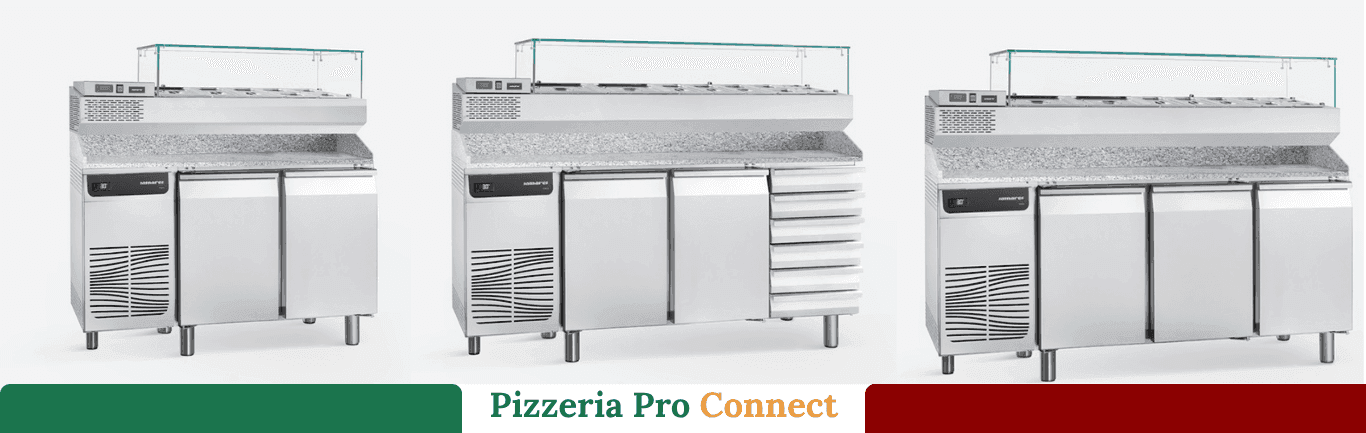
Choosing the right professional
pizza table.
How to Choose the Right Professional Pizza Prep Table
The professional pizza prep table is one of the central pieces of equipment in a pizzeria. It serves as a work surface, a refrigerated storage unit, and, depending on the configuration, a base for an ingredient rail.
But be careful: two pizza prep tables can look similar and still offer very different performance. Dimensions, cooling type, refrigerant gas, motor power, number of doors, options, delivery — several factors need to be checked before buying.
A pizza prep table shouldn't be chosen on looks alone
In photos, many pizza prep tables look alike: stainless steel, granite worktop, doors, a spot for an ingredient rail. In practice, though, the differences can be significant.
Some tables are designed for moderate use in a well air-conditioned space. Others are built to handle heavier workloads, frequent openings, long services, and periods of intense heat.
The choice shouldn't be based on price or appearance alone. A pizza prep table needs to match your production volume, your workflow, your kitchen's temperature, and the type of service you run.
Cooling performance: never overlook this
The pizza prep table needs to keep stored ingredients and products at a suitable temperature. This is essential for organization, hygiene, and food safety.
But not all tables respond to heat the same way. During heat waves, or in a kitchen where the oven runs for several hours a day, the refrigeration unit is put under heavy strain.
This is where the quality of the equipment makes all the difference. An entry-level table may work fine under good conditions but show its limits when the ambient temperature rises sharply.
For a pizzeria, it's therefore important to prioritize sturdy, professional-grade equipment that can handle hot periods without losing performance.
Don't place the pizza prep table too close to the oven
Where you position the pizza prep table matters as much as which model you choose. Avoid placing it directly next to the oven, especially if the oven gives off a lot of heat.
An oven placed too close to the refrigerated unit can raise the temperature around the cooling system and force the table to run constantly to maintain the cold. The result: the motor wears out faster, energy consumption rises, and performance can drop, particularly during hot periods.
It's therefore advisable to leave enough space around the pizza prep table, follow the manufacturer's recommendations, and ensure good air circulation, particularly around the motor and ventilation grilles.
A high-end pizza prep table will be more resilient, but even the best equipment needs to be installed correctly to perform well.
Watch out for refrigerant gases and actual performance
There are several types of refrigerant gases. Depending on the model, a pizza prep table may use a different gas, with different performance and behavior.
Two tables can look identical, have the same length and the same number of doors, and still not offer the same ability to maintain cold under difficult conditions.
The gas used isn't the only criterion. You should also look at:
- the power of the refrigeration unit;
- the quality of the insulation;
- the equipment's climate class;
- the maximum ambient temperature it can handle;
- build quality;
- motor ventilation;
- where the table is positioned in the kitchen.
Go high-end to avoid unpleasant surprises
In a pizzeria, refrigeration is put through its paces. Doors are opened regularly, ingredients are handled continuously, the oven heats up the room, and services can run long.
Investing in a quality pizza prep table helps reduce the risk of breakdowns, temperature loss, or poorly preserved products.
A high-end table often costs more upfront, but it can prevent many issues:
- lost product;
- breakdowns mid-service;
- difficulty maintaining temperature;
- costly technical repairs;
- premature equipment replacement;
- stress during heat waves.
When opening a pizzeria, people often try to cut costs. But when it comes to refrigeration, caution is key. A pizza prep table is used every single day. It needs to be reliable.
Choosing the right length and number of doors
Pizza prep tables come in several lengths and configurations. You'll typically find models with two doors, three doors, or more depending on your needs.
The choice depends on your space, your production volume, and your workflow.
A shorter table can suit a small pizzeria or a tight space. A longer table lets you store more products and gives you a more comfortable worktop.
But be careful: the bigger the table, the more complex delivery becomes.
Delivery: watch out for tables over 2 meters
Beyond roughly 2 meters in length, often starting with 3-door models, delivery may require a larger truck or specific logistics.
This point matters a lot, especially if your pizzeria is located:
- in a city center;
- on a narrow street;
- in a pedestrian zone;
- down a hard-to-access alley;
- in a space with steps, a narrow corridor, or complicated access.
Some trucks can't get everywhere. This can lead to extra fees, a more complex delivery, or the need for specific handling arrangements.
Before ordering a large pizza prep table, you should therefore check:
- the width of the street;
- access to your premises;
- whether there are steps;
- door widths;
- whether the truck can park nearby;
- the weight and dimensions of the packaged equipment.
This detail is often overlooked at the time of purchase, but it can prove costly on delivery day.
Doors, drawers, and storage: check the configuration carefully
Pizza prep tables can be offered with several types of storage: doors, drawers, neutral or refrigerated compartments, depending on the model.
Never assume a drawer is automatically refrigerated. Depending on the configuration chosen, some tables may include drawers or storage spaces that are not refrigerated.
Before finalizing the quote, you should therefore carefully check:
- the number of doors;
- the interior volume;
- whether drawers are included;
- whether the drawers are refrigerated or not;
- the type of runners;
- the interior dimensions;
- compatibility with the tubs you use;
- how easy it is to clean.
A poorly chosen table can quickly become a daily hassle. The goal is a workstation that's practical, efficient, and suited to how you work.
The ingredient rail is often sold separately
This is a very important point: pizza prep tables are generally sold on their own. The ingredient rail placed on top isn't always included in the base price.
You should therefore carefully check whether the quote covers only the table, or whether the refrigerated ingredient rail is included.
The ingredient rail keeps the products used for topping pizzas within easy reach: cheeses, vegetables, cured meats, sauces, or other items depending on your menu.
It can be offered in several versions:
- ingredient rail with a sneeze guard;
- ingredient rail without a sneeze guard;
- different depths depending on the tubs used;
- a variable number of tubs;
- a version matched to the table's length.
The ingredient rail can be ordered with or without a sneeze guard. The version with a sneeze guard offers better protection for the ingredients and gives a more enclosed look, particularly if the pizza prep table is positioned facing customers. In that case, the guard is strongly recommended, both for hygiene, presentation, and product protection.
When the rail is placed against a wall, the guard isn't necessarily essential. A version without one avoids adding an extra surface to clean and also reduces the risk of items being placed on top of it. The choice therefore depends on where the table is located, your workflow, and your hygiene requirements.
Don't forget the gastronorm containers
Gastronorm containers aren't always included by default with the ingredient rail. Be sure to add them to the quote.
It's a small detail, but it can be frustrating at installation time. The table is delivered, the rail is in place, but the containers aren't provided or don't fit.
Before ordering, check:
- the compatible container sizes;
- how many containers you'll need;
- the depth of the containers;
- whether lids are included;
- compatibility with the rail you've chosen.
A rail that's properly equipped from the start lets you work more cleanly and efficiently.
Options to check before buying
A pizza prep table can be configured with various options depending on the model. These options can have a significant impact on installation and day-to-day use.
Options to check include:
- casters instead of feet;
- adjustable feet;
- motor on the right or left;
- built-in or remote refrigeration unit;
- number of doors;
- refrigerated or non-refrigerated drawers;
- ingredient rail with or without a sneeze guard;
- gastronorm containers included or extra;
- specific dimensions;
- stainless steel finish;
- cooling type;
- climate class;
- refrigeration unit power.
Casters can be very handy for moving the unit during cleaning or installation. Whether the motor is on the right or left can also matter depending on your kitchen layout.
A poorly positioned motor can complicate technical access or get in the way of movement around the workstation.
Think carefully about the pizza station's layout
The pizza prep table needs to fit into a genuine workflow. It's not enough for it to simply "fit" in the space. It needs to let the pizza maker work quickly, cleanly, and comfortably.
Before choosing, ask yourself the right questions:
- Where will the oven be placed?
- Where will the dough balls be stored?
- Where will the ingredients go?
- Will the pizza maker have enough room to stretch dough?
- Will the rail be easy to reach?
- Will the doors be able to open properly?
- Will the motor have enough air to breathe?
- Will cleaning be simple?
A table that's too small can slow down service. A table that's too large can complicate movement. A poorly placed table can get in the way of work instead of making it easier.
In summary
Choosing the right professional pizza prep table isn't just about picking a length or a number of doors. You need to look at cooling performance, resistance to high temperatures, refrigerant gas type, interior configuration, options, delivery, and essential accessories.
A good pizza prep table should be designed around your pizzeria, your production volume, and your space's constraints.
Before finalizing your purchase, always check:
- cooling performance;
- climate class;
- the unit's length;
- the number of doors;
- whether refrigerated drawers are included;
- the ingredient rail;
- the gastronorm containers;
- available options;
- delivery access;
- motor position;
- overall build quality.
The pizza prep table is a workstation used every single day. It's better to take the time to choose it carefully from the start than to end up with equipment that's too limited, poorly suited, or difficult to use day to day.
Request a quote
Which model or brand of electric oven interests you? Tell us your needs and we'll get back to you with a personalized offer.
Frequently asked questions
Can't find
the equipment you need?
Looking for a specific brand, a particular model, or professional equipment not yet listed on our site? Send us your request. We can look into your needs, offer you a quote on the equipment you're after, an equivalent solution, or help you find a better deal.